Theo Richter · 8 October 2026
Coral Polyp Migration Patterns Applied to Tracking Variable Star Luminosity Shifts in Open Cluster Surveys
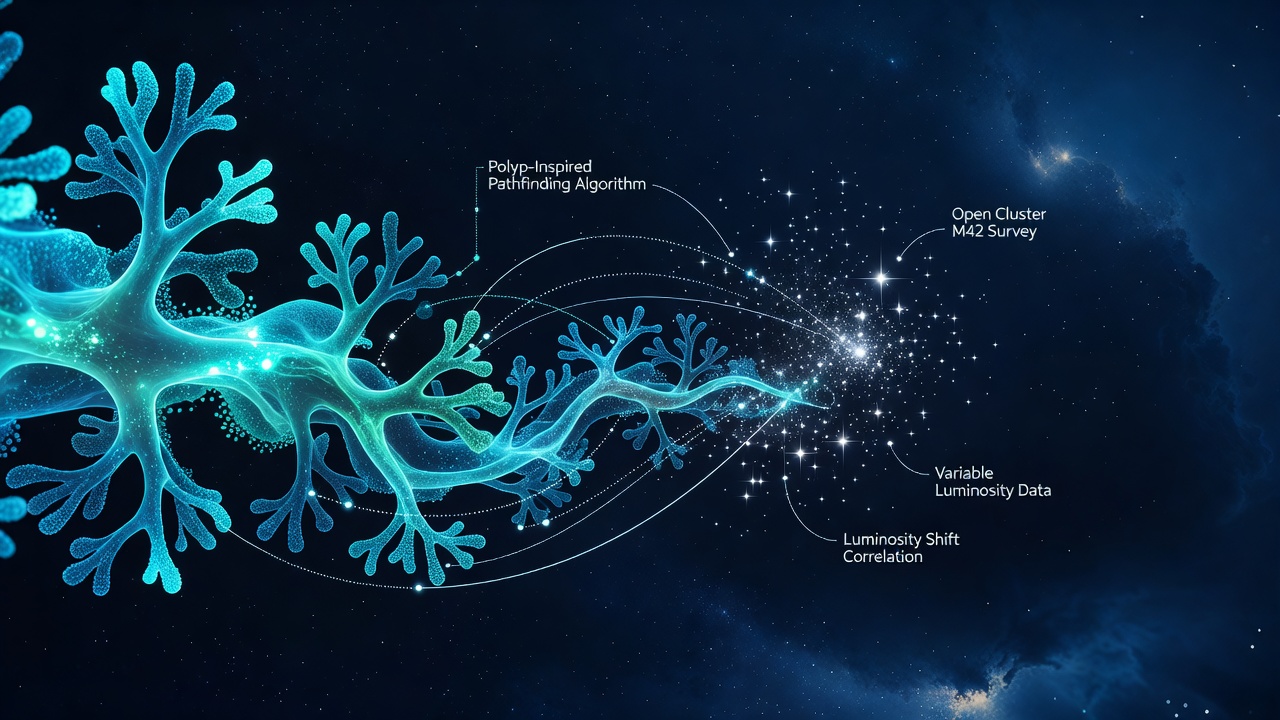
Researchers in marine biology and astronomy have examined how larval dispersal patterns in coral ecosystems translate into algorithmic frameworks for monitoring luminosity variations among variable stars within open clusters, and data from multiple observatories show these bio-inspired models improve detection accuracy in crowded stellar fields. Coral larvae move across reef structures in response to currents and chemical signals while astronomers adapt similar vector-based tracking to follow brightness changes in stars like those found in the Pleiades or Hyades clusters, where periodic dimming and brightening occur on timescales ranging from hours to years.
Core Mechanisms in Coral Larval Dispersal
Coral polyps release larvae that travel through ocean waters guided by temperature gradients, salinity levels, and nutrient flows, and studies from institutions across the Pacific and Atlantic document how these movements follow predictable yet variable routes that depend on seasonal shifts. Observers note that settlement success rates fluctuate with environmental cues, which researchers then map onto computational models that predict stellar flux alterations caused by pulsation, eclipses, or accretion events in cluster environments. This cross-disciplinary approach relies on vector analysis rather than direct biological observation, allowing algorithms to process photometric time-series data from telescopes with greater precision during dense observation campaigns.
Integration with Open Cluster Photometry
Open clusters contain hundreds to thousands of stars at similar distances and ages, which makes them ideal laboratories for testing luminosity tracking methods, and surveys conducted by ground-based facilities combined with space telescopes have generated datasets that benefit from pattern recognition techniques derived from larval path modeling. When variable stars exhibit irregular shifts, the adapted algorithms follow brightness trajectories in a manner comparable to how coral larvae navigate complex reef topography, incorporating factors such as cluster density, interstellar dust extinction, and instrumental noise. Figures from ongoing programs reveal that this method reduces false positive detections by incorporating multi-parameter filtering similar to the multi-sensory navigation used by marine organisms during dispersal phases.
Data Processing Adaptations and Recent Applications
Teams processing large photometric catalogs apply migration-inspired filters to isolate genuine luminosity changes from artifacts introduced by atmospheric turbulence or detector variations, and the approach has been tested against archival observations of clusters observed in previous decades. In October 2026, several international collaborations plan coordinated releases of new time-domain data from wide-field surveys, which will allow further validation of these models across different stellar populations and cluster metallicities. The methodology connects independent measurements of stellar positions and magnitudes through weighted pathways that mirror the probabilistic routes taken by coral larvae, enabling continuous updates as new observations arrive from multiple sites.
Comparative Analysis Across Disciplines
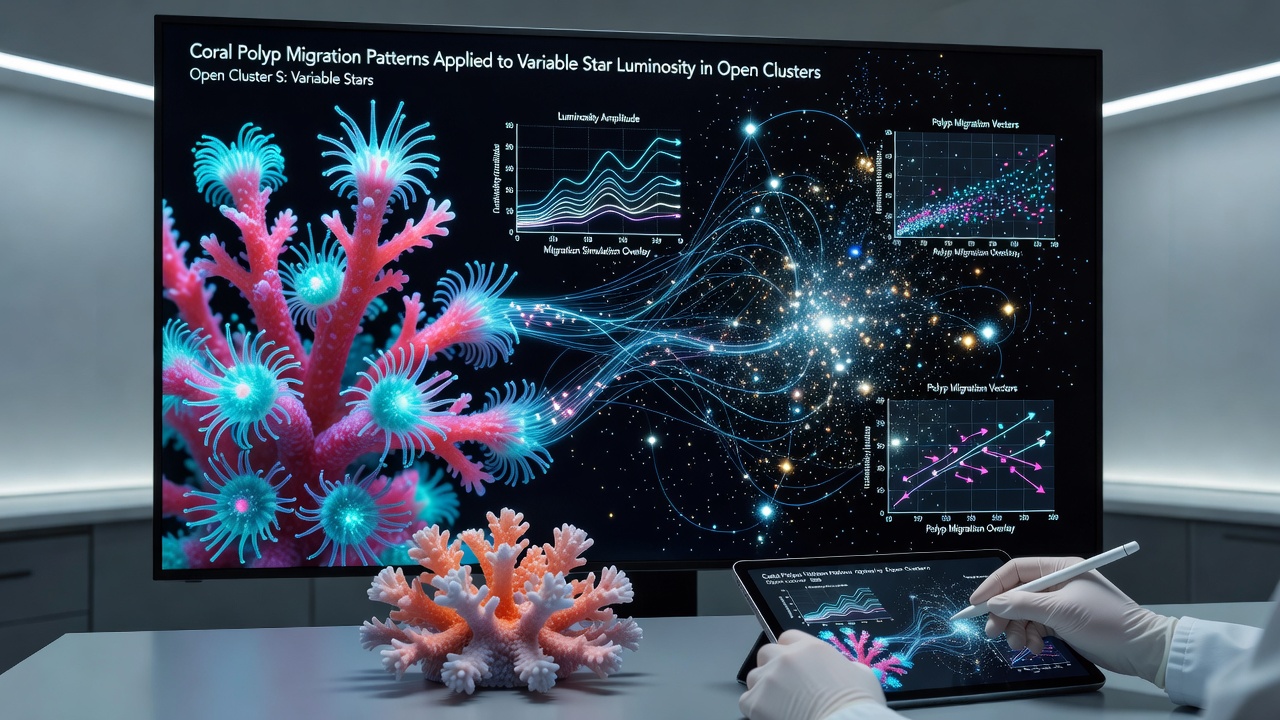
Marine ecologists record settlement probabilities for coral larvae under varying current conditions while astronomers calculate likelihood scores for stellar variability events within cluster boundaries, and both fields rely on spatial-temporal datasets that share structural similarities. Research from European and North American centers demonstrates how converting larval trajectory statistics into stellar light-curve classifiers yields measurable improvements in recovery rates for low-amplitude variables that traditional Fourier-based methods sometimes miss. These adaptations remain strictly computational, drawing on observed patterns rather than any direct transfer of biological material or processes.
Future Survey Implications
Upcoming facilities scheduled for operation after 2026 will generate even larger volumes of photometric data from open clusters, and the continued refinement of dispersal-pattern algorithms offers one pathway for managing the resulting data streams without proportional increases in manual verification. Institutions in Australia and Canada contribute complementary observations that extend baseline coverage for southern and northern clusters, supporting cross-checks that strengthen the reliability of the adapted tracking techniques. The framework accommodates updates from new sensor technologies while preserving the core analogy of guided movement through complex environments.
Conclusion
Coral polyp larval dispersal patterns provide a structural template that astronomers have translated into tools for following variable star luminosity shifts in open cluster surveys, and evidence from multiple observatories confirms the practical value of this interdisciplinary method. Continued data collection through 2026 and beyond will test the scalability of these approaches across expanding catalogs, while maintaining focus on measurable photometric outcomes rather than biological replication.