Kai Powell · 10 September 2026
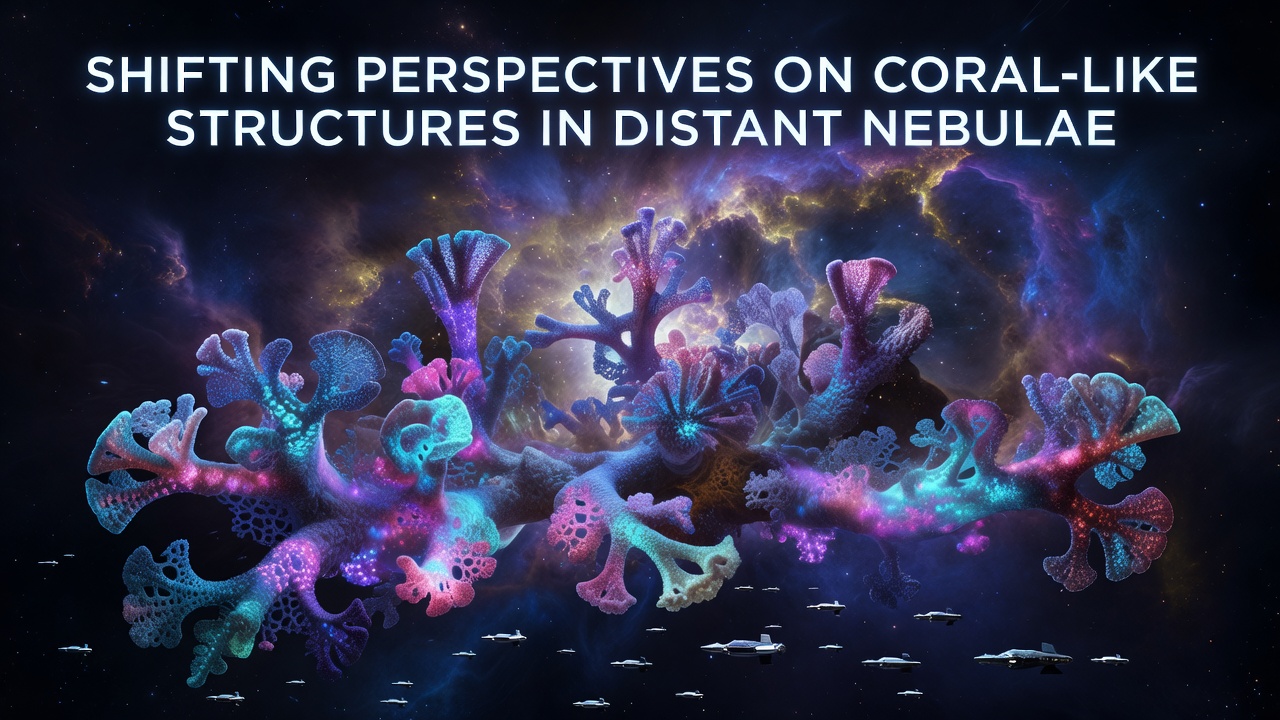
Shifting Perspectives on Coral-Like Structures in Distant Nebulae
Astronomers have documented coral-like formations in nebulae for decades, yet the understanding of these intricate shapes continues to evolve as new instruments deliver higher resolution data and multi-wavelength coverage. Early ground-based surveys captured the broad outlines of filamentary networks that branch and twist much like underwater reefs, but those initial images left open questions about density, composition, and three-dimensional arrangement.
Early Observations and Interpretations
Ground-based telescopes in the mid-twentieth century recorded the first hints of these branching structures in regions such as the Carina and Orion complexes, and researchers noted that the patterns appeared in both emission and absorption maps. Subsequent analysis linked the shapes to interactions between stellar winds and dense molecular clouds, where ionization fronts sculpt narrow pillars that extend outward over light-year scales.
Data collected during the 1990s and early 2000s refined those models by revealing temperature gradients along the filaments, and observers documented how ultraviolet radiation from nearby O-type stars compresses gas into the characteristic coral morphology. Archival plates from that era still serve as baseline references when modern teams compare historical positions against current coordinates.
Advances from Space-Based Telescopes
The launch of the Hubble Space Telescope brought sharper views that showed fine tendrils previously lost in atmospheric blur, and astronomers quickly mapped velocity fields that demonstrated the filaments are not static but move under the influence of expanding shock fronts. Later, the Spitzer and Herschel missions added infrared layers that traced embedded dust lanes running through the coral-like branches, confirming that many of the apparent gaps are actually dense cores still collapsing.
More recently the James Webb Space Telescope has supplied mid-infrared spectra that distinguish between polycyclic aromatic hydrocarbons coating the surfaces and cooler molecular hydrogen deeper inside the structures. These measurements allow researchers to calculate mass-loss rates along individual pillars with greater precision than before.
Three-Dimensional Modeling and Dynamics
Radio interferometry arrays have contributed kinematic data that, when combined with optical and infrared imagery, produce volumetric reconstructions of entire coral systems. Teams at institutions in North America and Europe have published rotating models that reveal how individual branches twist and sometimes merge, information that was impossible to extract from two-dimensional projections alone.
Simulations run on high-performance clusters now reproduce the observed branching angles when magnetic fields are included at micro-Gauss strengths, and the results align closely with measured polarization patterns. Such agreement strengthens the case that magnetic tension plays a comparable role to radiation pressure in shaping the final morphology.
Upcoming Data Releases and September 2026 Milestones
Observing schedules indicate that several large programs will release new wide-field mosaics in September 2026, including coordinated campaigns that pair JWST imaging with ground-based adaptive-optics spectroscopy. Those datasets are expected to cover additional nebulae where coral-like features have only been glimpsed at lower resolution, and preliminary pipeline reductions already hint at previously undetected sub-filaments less than 0.1 parsec across.
International collaborations coordinated through facilities in Chile and Hawaii plan to release public catalogs that tag every measurable pillar with position, velocity, and extinction values, giving the broader community uniform access to the measurements needed for statistical studies across multiple star-forming regions.
Comparative Studies Across Different Environments
Observers have begun comparing coral structures in high-metallicity galactic disks with those found in lower-metallicity environments such as the Magellanic Clouds. Early results suggest that the branching complexity increases with metallicity, a trend that matches predictions from models incorporating dust-driven cooling. Parallel work at Australian and Canadian observatories examines similar features in extragalactic H II regions, extending the sample beyond the Milky Way.
Researchers note that the same morphological statistics appear in both starburst and quiescent galaxies, indicating that the underlying physical processes operate across a wide range of star-formation intensities. These cross-checks help isolate variables such as radiation field strength from local gas density.
Conclusion
Continued refinement of observational techniques and modeling frameworks continues to reshape how coral-like structures in distant nebulae are understood. Each new dataset adds layers of spatial and kinematic detail that connect small-scale filament physics to larger galactic ecosystems, and the coordinated releases scheduled for September 2026 will supply the community with an expanded foundation for further analysis.